Notice items 1, 5, 10 and 11 · PDF page 3; ITB opening paragraphs · PDF page 17; ITB Note 7(4) · PDF page 22; NBCC Corrigendum-7, 19 Aug 2026, for the July sale
Is the Avenue Towers e-auction back on after July’s cancellation?
Yes. NBCC cancelled the July sale on 19 Aug 2026, and on 3 Oct 2026 it offered the same 262 apartments again under a new application, NBCC/Sr. ED/2026/740, at the same reserve prices and EMDs. The EMD closes on 17 Oct 2026 at 8:00 PM IST, the mock e-auction is on 18 Oct, and the live e-auction is on 19 Oct 2026 from 12:00 to 2:00 PM IST, extended 8 minutes at a time while bids keep arriving. Several terms changed from July, as the answers below explain. NBCC says any corrigendum will appear only on its own website, and asks bidders to download a fresh copy of the application at least a day before the auction.
Notice closing note; ITB Notes 4(3) and 7(2)–(3); terms clause 18; acceptance letter item 3 · PDF pages 4, 16, 19, 22 and 34; bidder manual step 39
Can I bid on more than one apartment?
No — this is the biggest change from July. Each valid PAN may make one application, pay one EMD and bid on one apartment, and NBCC allots no more than one apartment per PAN. Every PAN in an application counts: the sole applicant, each joint applicant, a proprietor, and an HUF together with its Karta, which count as one. No PAN may appear in more than one application that leads to an allotment, and nobody may end up with a second apartment through a joint applicant, nominee, agent, benamidar or an entity under common control or ownership. An application that breaks the rule can be rejected or cancelled. Two older passages were not updated to match: Note 7(2) still describes bidding on other units with the same payment details, and step 39 of the bidder manual, a 28 Jul file, describes bidding on several items with an EMD for each. Note 7(3) applies “notwithstanding anything contained elsewhere”, so choose your one apartment before you pay.
Terms clauses 16.1, 24.1–24.6 and 30.8; draft agreement for sale clauses 8.3(iii), 30.2–30.3 and 32 · PDF pages 34, 36–37, 39, 51 and 55–56
Can I sell or transfer the apartment before the conveyance deed?
Not to an outsider. July’s application let a buyer ask MoHUA to change the allotment to a third party once 50% was paid, for a 2% charge; that route is gone. Clause 24.1 now says possession and the conveyance deed go to the original bidder only and that the unit “cannot be alienated in any manner whatsoever”, and clause 16.1 executes the deed only if the allottee has not sold, transferred or alienated any part of the flat or parted with its possession. If NBCC finds a resale or change of ownership at any time, clause 24.2 lets it cancel the allotment, forfeit money under the cancellation clause and take the flat back. The draft agreement for sale annexed to the application, which says it prevails, goes further for a resale or transfer “without making full payment to NBCC/MoHUA by taking physical possession and followed by execution of Conveyance Deed”: its clause 8.3(iii) applies “notwithstanding anything to the contrary” and lets MoHUA “forfeit any amounts paid”, so a resale before the deed could cost everything paid, not only the cancellation deduction. Title passes only once the deed is registered. Three changes stay free: adding or removing a joint applicant who is a blood relation, once; a transfer to a spouse, parent, child or sibling; and replacing a deceased applicant with the legal heirs. NBCC told July’s bidders a buyer could let the flat out; with clause 16.1’s new wording, ask NBCC in writing before planning to rent it out before the deed. Whether you can resell after the deed is not settled: clause 24.1, repeated as the agreement’s clause 30.2, sets no end date, while clause 8.3(iii) is aimed at a resale before full payment, possession and the deed. Ask NBCC in writing before counting on a resale after the deed, or ruling one out.
ITB Note 6; terms clauses 3, 4, 16.4, 23 and 24.6–24.7; draft agreement for sale clauses 4.5 and 32 · PDF pages 21, 26–27, 34, 36–37, 48 and 56
What do I lose if I pull out or fall behind on payments?
Missing the booking payment — 10% of the bid, less the EMD, within 15 days of the close — forfeits the whole EMD, as in July. After that, the deduction is now “10% of the Deposited amount or EMD amount whichever is higher”, where July deducted 10% of the bid value. It applies if you withdraw, plus taxes, or if NBCC cancels for your default, including a payment more than two consecutive months late. On either reading of that phrase, early in the payment plan it is far less than July’s 10% of the bid value. Clause 23 returns the rest without interest within 60 working days of the cancellation being approved. The draft agreement for sale annexed to the application, which says it prevails where the two differ, returns the balance to a buyer who withdraws through no fault of L&DO/MoHUA “within 45 days of such cancellation”, so ask NBCC which period applies to you. Late payments carry simple interest at SBI’s highest MCLR plus 2%. Separately, if the winning bidder dies before the conveyance deed, clause 23 lets NBCC, with approval, refund what was paid less the same deduction, while clauses 16.4 and 24.7 give the deed and the right to occupy to the legal heirs. The document does not say which applies.
Terms clauses 11 and 25.2; Annexure-V affidavit item 5; draft agreement for sale clauses 14.2 and 32 · PDF pages 29, 37, 41, 52 and 56
Can I renovate or change the layout?
Not structurally under the October terms, though the agreement annexed to them still says otherwise. July allowed structural changes with written permission from NBCC, the maintenance agency, the residents’ association and the authorities. Clause 11 now bars any structural addition or alteration in the flat or the complex, any sub-division or merger with another flat and any change to the façade or its colours, and the flat may be used only as a home. Every bidder also signs an affidavit undertaking not to make additions, structural changes or alterations, and NBCC/MoHUA may cancel the allotment and take the flat back if that undertaking is broken. But clause 14.2 of the draft agreement for sale annexed to the same document still bars structural additions or alterations only “without written permission” from L&DO/MoHUA, the maintenance agency, the residents’ association or the authorities, and its clause 32 says the agreement prevails where it differs from the auction documents. NBCC has not reconciled the two, so plan on no structural change unless NBCC confirms otherwise in writing. Interior work that clause 11 does not prohibit is allowed, with the owner responsible for its structural safety.
ITB Note 4; application form item 4; terms clause 30.6; Annexure-V · PDF pages 12, 18–19, 39 and 41
Who can bid, and can NRIs apply?
Individuals aged 18 or over on the last date of application, with a valid PAN quoted in the form; firms, LLPs, trusts, co-operative societies, companies, government departments and public-sector bodies; and an HUF through its Karta. Applications by or for minors are no longer accepted — July allowed them through a guardian — and NBCC suggests adding any co-applicant at the application stage. July’s notes on foreign companies and on NRI, PIO and OCI bidders, and the agreement’s clause on foreign-exchange rules for remittances, have all been removed. The document now neither admits nor bars NRIs in so many words, though the application form still asks whether the buyer is competent to contract under FEMA and India’s FDI policy, so NRIs should ask NBCC in writing. Anyone terminated or blacklisted in a property auction by a government body, PSU, RERA or NBCC in the last three years is barred, and every bidder files a notarised affidavit.
ITB Note 6 and Note 7(8) · PDF pages 20–23
What does the winner pay, and when?
The EMD, 2% of the reserve, counts towards the price. Within 15 days of the close the winner brings the payment to 10% of the bid, paid to MoHUA. Eight more 10% instalments follow construction, each due at the later of a stage or a fixed number of months from the allotment letter: foundation or 3 months; the 3rd, 6th, 8th and 10th-floor slabs or 6, 8, 10 and 12 months; flooring or 14 months; the façade or 16 months; and the offer to start fit-out work. The last 10% is due within 60 days of the offer of physical possession, with IFMS at ₹200 per sq ft, a ₹5 lakh club charge plus GST and two years’ maintenance in advance. NBCC sends a demand letter for each stage, payable within 30 days, and the third instalment waits for the agreement for sale. New in October: a bank or financial institution lending to the buyer for this flat may pay its disbursement directly; otherwise payments must come from the buyer’s own account.
Terms clauses 12.1–12.4; draft agreement for sale clauses 9 and 32 · PDF pages 30–31, 51 and 56
How fast do maintenance charges rise?
More slowly than in July. Maintenance is ₹6 per sq ft a month, two years of it paid in advance before possession and then quarterly in advance. It rises 10% after the first two years and then 15% at the end of every three years; July’s application said 20% each time. Clause 12.1 starts charges when you take possession, or 60 days after the offer of possession if that is earlier, once NBCC has the occupancy certificate. The clause 12.3 rate table starts them from the offer of possession, and so does clause 9 of the draft agreement for sale annexed to the application, which says it prevails: charges apply “from the date of offer for taking over of possession”. So budget for up to 60 days more. July’s rule starting them from the handover of 20% of the complex is gone. Electricity in the flat, any extra electrical load and periodic overhaul or replacement of equipment are billed separately at cost.
Annexure I and its notes; ITB Notes 3 and 7(1); terms clause 29 · PDF pages 5–11, 18, 22 and 38; Delhi RERA registration certificate, condition 2(xii), page 3
How are the apartments priced and bid?
Every apartment starts at ₹37,161 per sq ft of super built-up area, which includes three covered car parking spaces, and bids rise in steps of at least ₹100 per sq ft; a bid at the reserve is valid. Annexure I also prints a rate per sq ft of carpet area, ₹62,555.51–₹68,370.76, and October adds a note that this column is indicative only: bids are invited and evaluated on the super built-up rate. Delhi RERA’s registration certificate for the project points the other way: its condition 2(xii) says the promoters “shall advertise, market or sale the project only on carpet area basis and not on the basis of super area or super built-up area basis”. The application does not explain how the two fit, so ask NBCC in writing how the price will be stated in your allotment letter and agreement. The 262 apartments, their areas, reserves and EMDs are identical, row for row, to July’s list. NBCC/MoHUA may still reject the highest bid, which stays open for acceptance for 90 days.
Annexure I · PDF pages 5–11
Where is the price list for all 262 flats?
Annexure I of NBCC’s application lists every apartment with its tower, floor, unit number, type, super built-up and carpet areas, reserve price and EMD. Reserves run from ₹15,75,36,395 to ₹17,76,12,446, all at ₹37,161 per sq ft of super built-up area, and EMDs from ₹31,50,728 to ₹35,52,249. Bids are made on that super built-up rate; Delhi RERA’s certificate asks for sale on carpet area instead, which the pricing answer above covers. Our research sets out the same list tower by tower.
Annexure I note (iii); terms clause 8; Annexure-5 · PDF pages 11 and 28–29
Where is the parking, and how is it allotted?
Three covered car parking spaces come with each apartment, in Lower Basements 1 and 2, and the reserve includes them. They may be anywhere in the basement and need not be next to each other. NBCC says it will try to place them beneath your tower, allots single and stacked spaces proportionally once the building is complete, and its decision is final; three scooter or bike spaces count as one car space. Surplus parking and other basement space belong to MoHUA, which may sell or allot them to any buyer. The circulation plan NBCC published with this round shows a vehicle entry and exit at each end of the site, one beside 3rd Cross Road, with pedestrian and service entries from Africa Avenue; residential drop-offs and a community drop-off on the internal road; two basement ramps off that road, one between Towers 2 and 3 and one between Towers 7 and 8; and a 6 m fire-tender route along the road and round the west side of every tower. Our complex layout on each tower page draws them.
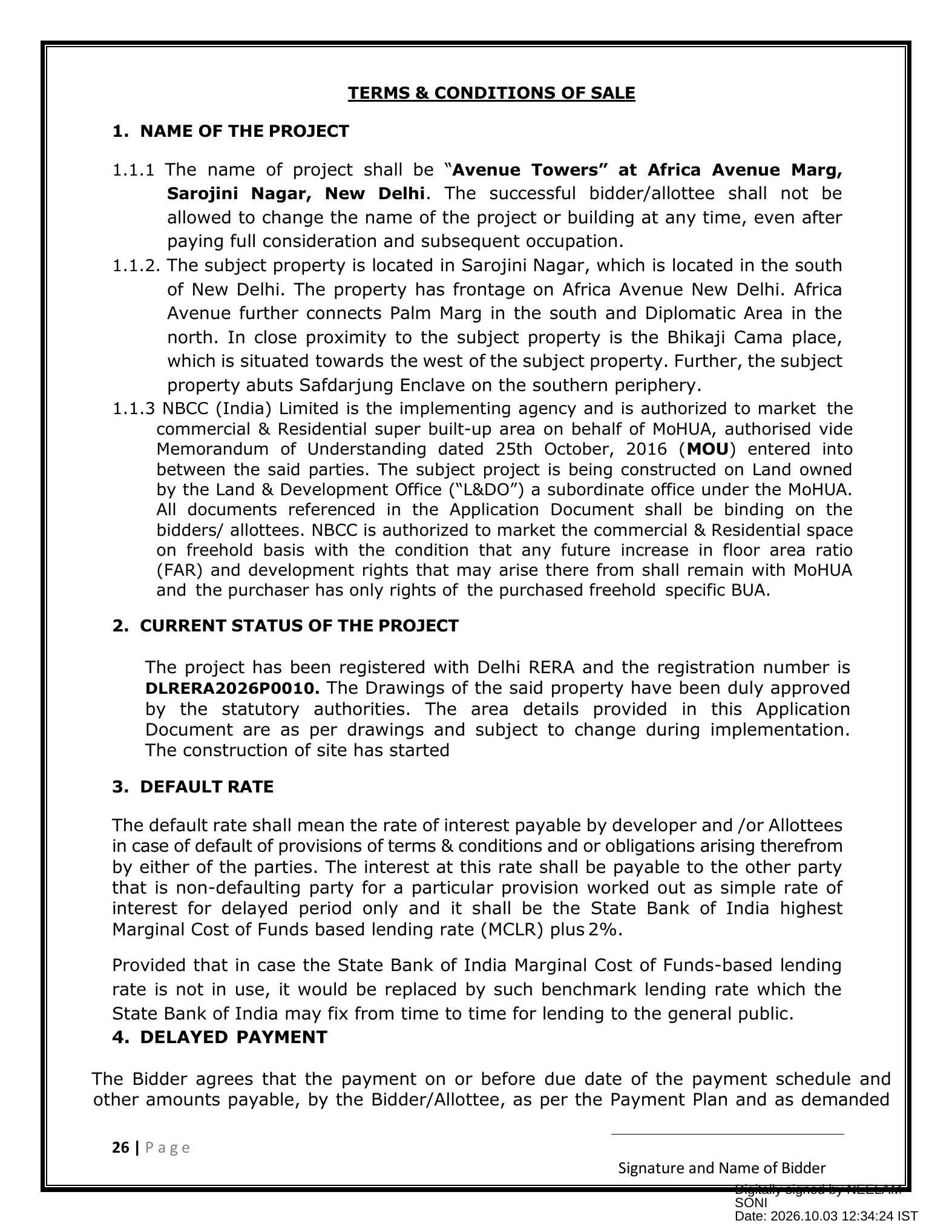
Terms clauses 1.1.1–1.1.3 · PDF page 26
Where exactly is Avenue Towers?
NBCC’s application names the project “Avenue Towers” at Africa Avenue Marg, Sarojini Nagar, New Delhi, with its frontage on Africa Avenue. It says Africa Avenue connects Palm Marg in the south and the Diplomatic Area in the north, puts Bhikaji Cama Place close by to the west, and says the site abuts Safdarjung Enclave on its southern periphery. The land belongs to the Land & Development Office under MoHUA, and NBCC markets the apartments on MoHUA’s behalf as its implementing agency. Our research draws the complex, its internal road and its entries on a layout plan.
Terms clauses 7 and 24.3 · PDF pages 28 and 37
Who owns the terrace?
Not the buyers. Clause 7 says that even after the conveyance deeds the Government of India keeps exclusive rights to the terrace and may add floors or structures there, subject to applicable law, and owns and may sell whatever it builds; NBCC bears the cost of connecting it to services, and buyers cannot claim a lower price for the inconvenience. Any future increase in floor area ratio also stays with MoHUA. In July a bidder asked for the clause to be deleted and NBCC replied that the bid document prevails; October keeps it unchanged.
Notice items 4–11 and closing notes; ITB opening paragraphs and Notes 1–2; terms clause 28 · PDF pages 3–4, 17–18 and 38
How do I take part, and where do I ask questions?
Enrol as a bidder on RailTel’s eNivida portal for NBCC, pay the ₹1,770 registration fee and the ₹17,700 auction-processing fee, and pay the EMD for your chosen apartment through the portal’s online gateway by 17 Oct, 8:00 PM IST; NBCC accepts it in no other form. Then email your payment and refund-account details to the NBCC address printed in the document. The eNivida helpdesk gives free portal training on request until the day before the 18 Oct mock auction. There is no pre-bid meeting this time: clause 28 takes written questions only until 7 days before “the schedule date of submission of offer document”, which the document does not define — 10 Oct, counting back from the EMD deadline, by our reading. NBCC says it will try to reply by email, and anyone who goes on to bid is treated as having no question left unanswered. NBCC may issue a corrigendum up to two days before the auction, only on its own website, and asks bidders to download a fresh copy at least a day before.
NBCC Corrigendum-2, 24 Jul 2026, for the cancelled July sale; October brochure
Do NBCC’s July pre-bid answers still apply?
Partly. NBCC answered bidders’ questions on 24 Jul for the July sale it later cancelled, in a table headed “Draft Reply”. Its answers about the building describe the same nine towers in the same brochure, which NBCC has republished unchanged: a single row of towers set back 12–15 m from the boundary wall, with L-Avenue Road and RBI quarters behind; no air-conditioning inside the flats; built-in wardrobes; 3.22 m floor to floor; about 852 basement parking spaces and 99 EV-charging points; a 247 KLD sewage plant; and the clubhouse within Towers 4–6. Its answers about terms do not carry over where October changed them — the 2% transfer charge and the 20% maintenance rise among them — and NBCC has not said whether the rest still hold for this round. Our July record keeps every answer with its date.